EPC compliance UK - Bournemouth EPC Service ...

Book Your EPC

Select Date & Time

Your Reservation

{service_name}
{reservation_date} · {reservation_time}

Location

{location_name}

Clients

{reservation_capacity}

Employee

{employee_name}

Price

{reservation_price}
Your cart is empty.

Total: £0

Your Information

Required fields are followed by *.

Your Order

Payment Method

  • Make your payment directly into our bank account.

    You will receive payment details immediately after booking.

  • Pay with your debit or credit card via Stripe.

Making a reservation...

·

Tag: EPC compliance UK

Commercial EPC Southampton: A New Local Service

Bournemouth EPC Service has launched a new, dedicated service called Southampton Commercial EPC to support businesses that need a commercial EPC Southampton assessment delivered locally and efficiently.

As a result, Southampton businesses now have a clearer and simpler way to arrange compliance without dealing with national call centres or generic providers.

Until now, Bournemouth EPC Service has delivered commercial EPCs across the South Coast.
However, Southampton has a large and active commercial property market.
Because of this, a local-first service makes practical sense.

So, Southampton Commercial EPC now acts as the main entry point for Southampton enquiries.
At the same time, Bournemouth EPC Service continues to carry out all assessments.

Commercial EPC Southampton service covering Southampton business properties
Commercial EPC services for Southampton business buildings

Why We Launched a Southampton-Focused Commercial EPC Service

Many EPC providers operate nationally.
Unfortunately, that often creates delays and confusion.

For example, businesses may face:

  • Slow booking times
  • Poor communication
  • Generic reports with little value

Because of this, compliance becomes harder than it should be.

By contrast, Southampton Commercial EPC removes these issues.
It focuses only on Southampton properties.
As a result, the process becomes faster and clearer.

In practice, this means:

  • Faster local scheduling
  • Easier site access
  • Clear communication throughout
  • Assessments completed by qualified commercial assessors

In short, businesses deal with a local service instead of a call centre.


Delivered by Bournemouth EPC Service

Importantly, Southampton Commercial EPC is not a separate assessment company.

Instead, the assessment team at Bournemouth EPC Service completes every EPC.
Because of this, clients benefit from experience as well as local focus.

This approach ensures:

  • Consistent assessment methods
  • Accurate and compliant reports
  • Experience with complex commercial buildings

Therefore, Southampton clients gain a local service without losing quality.

If you need commercial EPCs outside Southampton, you can view our main service here:
👉 https://www.bournemouthepcservice.co.uk


Commercial EPC Southampton assessment in a modern office building

Using EPCs for Better Energy Decisions

A commercial EPC is a legal requirement.
However, it should not stop there.

For this reason, Bournemouth EPC Service works alongside Digital Energy Revolution Ltd.

Once an EPC is complete, it can help businesses:

  • Spot energy waste
  • Reduce running costs
  • Prepare for MEES compliance
  • Plan future energy decisions

As a result, the EPC becomes useful, not just compliant.

To learn more, visit:
👉 https://www.digitalenergyrevolution.co.uk/


Key Benefits of Southampton Commercial EPC

Ultimately, this service exists to reduce friction.

Specifically, it offers:

  • A Southampton-only focus
  • Qualified commercial assessors
  • Clear expectations from the start
  • Fast turnaround times
  • Plain-English compliance guidance

Because of this, businesses receive a commercial EPC Southampton service that works in practice.


UK Commercial EPC Compliance

All EPCs are completed in line with current UK law.
In addition, we lodge every EPC on the official register.

As enforcement increases, this matters more than ever.

For official guidance, see:
👉 https://www.gov.uk/buy-sell-your-home/energy-performance-certificates


Who This Service Is For

Southampton Commercial EPC suits:

  • Commercial landlords
  • Managing agents
  • Business owners
  • Property investors
  • Advisors handling sales or leases

Whether you are selling or letting, this service keeps things simple.


Book a Commercial EPC Southampton Assessment

If you need a commercial EPC Southampton assessment, the process is now easier.

Submit your details through our Southampton service.
After that, we handle the rest.

👉 https://www.southamptoncommercialepc.co.uk/

Local focus. Proven delivery. Clear compliance.


Frequently Asked Questions: Commercial EPC Southampton

Do I need a commercial EPC in Southampton?

Yes. You need a commercial EPC when you sell, lease, or build a non-domestic property.
A qualified assessor must complete and register it.


What buildings need a commercial EPC?

Commercial EPCs apply to offices, shops, warehouses, and industrial buildings.
Domestic EPCs do not apply to commercial premises.


How long does the assessment take?

Most site visits last between 30 minutes and a few hours.
In most cases, reports follow within a few working days.


Is Southampton Commercial EPC a separate company?

No. It is a Southampton-facing service supported by Bournemouth EPC Service.
Because of this, clients receive local access and proven experience.


Can an EPC help reduce energy costs?

Yes. While the EPC meets legal rules, it also highlights inefficiencies.
Therefore, many businesses use it as a starting point for savings.


EPC Myths That Could Be Holding Back Your Property’s Value

When it comes to selling, renting, or managing property, your Energy Performance Certificate (EPC) matters more than you might think. Yet, many landlords and homeowners still believe common EPC myths that could be quietly reducing their property’s value or limiting opportunities.

In this article, we’ll debunk the biggest EPC myths — and show you how understanding the truth can protect both your home and your investment.

Illustration of common EPC myths with homes, a magnifying glass, and an energy rating chart, highlighting their impact on landlords and homeowners.

EPC Myths 1: “Improving an EPC Rating Always Costs Thousands”

Many property owners assume that the only way to improve an EPC rating is through expensive upgrades like solar panels or full heating system replacements.

👉 The truth: Small, affordable changes can often boost a rating by one or even two bands.

  • Switching to LED lighting
  • Adding loft insulation
  • Installing basic heating controls

These low-cost measures not only help domestic homes but can also be applied in smaller commercial units such as offices and shops.

🔗 Read our guide on how to reduce business energy costs for practical tips.


EPC Myths 2: “Tenants Don’t Care About EPC Ratings”

Some landlords think tenants only look at rent and location. However, research shows more and more renters are asking about energy bills before signing a tenancy.

👉 The truth: A higher EPC rating often makes a property more attractive to tenants, reduces void periods, and allows landlords to justify stronger rental values.

For commercial landlords, energy efficiency can also help attract long-term tenants who want to reduce their operating costs.


Myth 3: “EPCs Are Just a Legal Box-Ticking Exercise”

Yes, EPCs are a legal requirement when selling or letting. But they are also a valuable insight into a property’s long-term efficiency and comfort.

👉 The truth: EPCs are not just about compliance — they’re also a marketing tool. A higher rating can add to your property’s selling points and support mortgage applications, including green mortgages that offer better rates.

If you’re unsure about the quality of your EPC, consider the benefits of choosing a local EPC assessor who understands property types in Bournemouth, Christchurch and Poole.


Myth 4: “Commercial Properties Don’t Need to Worry About EPCs Yet”

Some business owners assume EPC requirements are only being tightened for domestic landlords.

👉 The truth: Commercial EPC rules are also changing. Minimum EPC standards apply to many rented business premises, and proposed regulations could see minimum requirements rise in the coming years. This means SMEs in Bournemouth, Christchurch and Poole must prepare now — just like homeowners and private landlords.

For further details, see the UK Government EPC guidance.


Why Busting These EPC Myths Matters

By believing these EPC myths, landlords and homeowners risk:

  • Lower property values when selling
  • Longer void periods when renting
  • Higher running costs for both domestic and commercial tenants
  • Potential fines for non-compliance as regulations tighten

How Bournemouth EPC Service Can Help

At Bournemouth EPC Service, we provide accurate, affordable EPC assessments across Bournemouth, Christchurch and Poole. More importantly, we help you understand what your EPC really means — and how to improve your rating without unnecessary expense.

Whether you own a domestic property, manage a rental portfolio, or operate a small business premises, we’ll give you practical, tailored advice.

👉 Don’t let EPC myths hold back your property’s value. Book your EPC today and take control of your property’s energy performance.

Minimum EPC D Standard: What Landlords Need to Know

Energy efficiency is a hot topic in the UK housing market, and the minimum EPC D standard is set to play a major role in the coming years. The government has proposed raising the legal requirement for rental properties from the current minimum of E to a minimum EPC ‘D’ rating. While timelines have shifted, the direction of policy is clear: landlords, homeowners, and investors in BCP (Bournemouth, Christchurch and Poole) must prepare for tougher standards.


What Is the Minimum EPC D Standard?

An Energy Performance Certificate (EPC) measures the energy efficiency of a property on a scale from A (most efficient) to G (least efficient). Currently, all rental properties in England and Wales must meet at least an EPC band E before being let. The minimum EPC D standard proposal would tighten these rules, meaning landlords could no longer let properties rated E or below without upgrades.

👉 Learn more about what’s included in an EPC assessment here.


Who Will the Minimum EPC D Standard Affect?

The minimum EPC D standard will impact:

  • Private landlords – who must ensure properties meet the new level before new tenancies.
  • Property investors – whose portfolios may require upgrades.
  • Homeowners – especially those planning to sell, as buyers increasingly value energy efficiency.

Across Bournemouth, Christchurch and Poole, many older homes are likely to struggle to reach band D. Examples include:

  • Victorian terraces in Charminster – solid walls, difficult to insulate.
  • 1930s semis in Christchurch – often with outdated boilers and single glazing.
  • Converted flats in Poole town centre – mixed insulation and heating efficiency.

The Costs of Meeting the Minimum EPC D Standard

Improving your EPC rating doesn’t always mean expensive renovations. In fact, there are many cost-effective upgrades that help properties meet the minimum EPC standards:

  • Loft insulation – often the cheapest and most effective step.
  • Cavity wall insulation – reduces heat loss in suitable properties.
  • Efficient heating systems – modern boilers or smart controls.
  • Lighting upgrades – replacing bulbs with LEDs.

For practical advice, see our guide on understanding your business energy bill — many of the same principles apply to cutting home energy costs.


Penalties for Ignoring the Minimum EPC D Standard

If the minimum EPC D standard becomes law, landlords who fail to comply could face:

  • Financial penalties – fines up to thousands of pounds.
  • Restrictions on letting – non-compliant properties cannot be rented.
  • Reduced property value – poor EPC ratings put off buyers and tenants.

Why Act on the Minimum EPC D Standard Now?

Although timelines have shifted, landlords and homeowners in BCP should not delay. Acting early on the minimum EPC D standard allows you to:

  • Spread out improvement costs.
  • Increase property value before selling.
  • Avoid non-compliance penalties.
  • Lower energy bills for tenants or occupants.

How Bournemouth EPC Service Can Help

The first step towards compliance with the minimum EPC D standard is knowing your current rating. At Bournemouth EPC Service, we provide affordable, accurate EPC assessments across Bournemouth, Christchurch and Poole.

Wondering if a local assessor makes a difference? Read about the benefits of choosing a local EPC assessor.


FAQs About the Minimum EPC D Standard

🔹 When will the minimum EPC D standard start?
Originally proposed for 2025, but delayed. Expect tougher rules soon.

🔹 How long does an EPC last?
10 years, unless major changes are made.

🔹 What’s the penalty for ignoring the minimum standards?
Fines of up to £5,000 or more, plus rental restrictions.

🔹 Will homeowners need to upgrade before selling?
No fines, but poor EPC ratings lower property value.

🔹 What are the cheapest upgrades?
Loft insulation, LED lighting, and heating controls. See our guide to reducing energy costs.

👉 For landlords, the National Residential Landlords Association offers extra compliance guidance.


Final Thoughts

The minimum EPC D standard is a key change for landlords and homeowners across Bournemouth, Christchurch and Poole. Preparing early will avoid penalties, reduce energy costs, and protect property values.

👉 Don’t wait until it’s too late — book your EPC today and get ahead of the minimum EPC D standard.

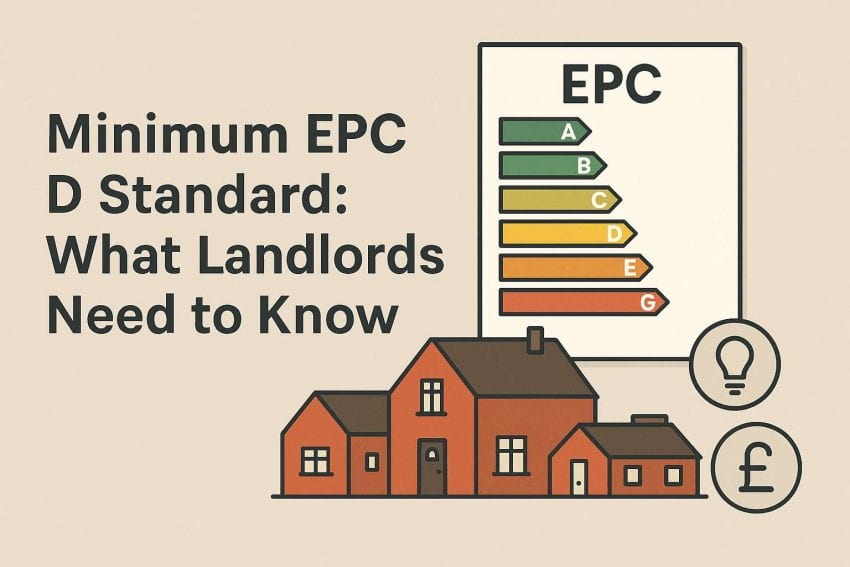
Houses with EPC energy rating chart highlighting the proposed minimum EPC D standard in Bournemouth, Christchurch and Poole.
Illustration of the UK’s minimum EPC D standard and its impact on landlords and homeowners in Bournemouth, Christchurch & Poole.